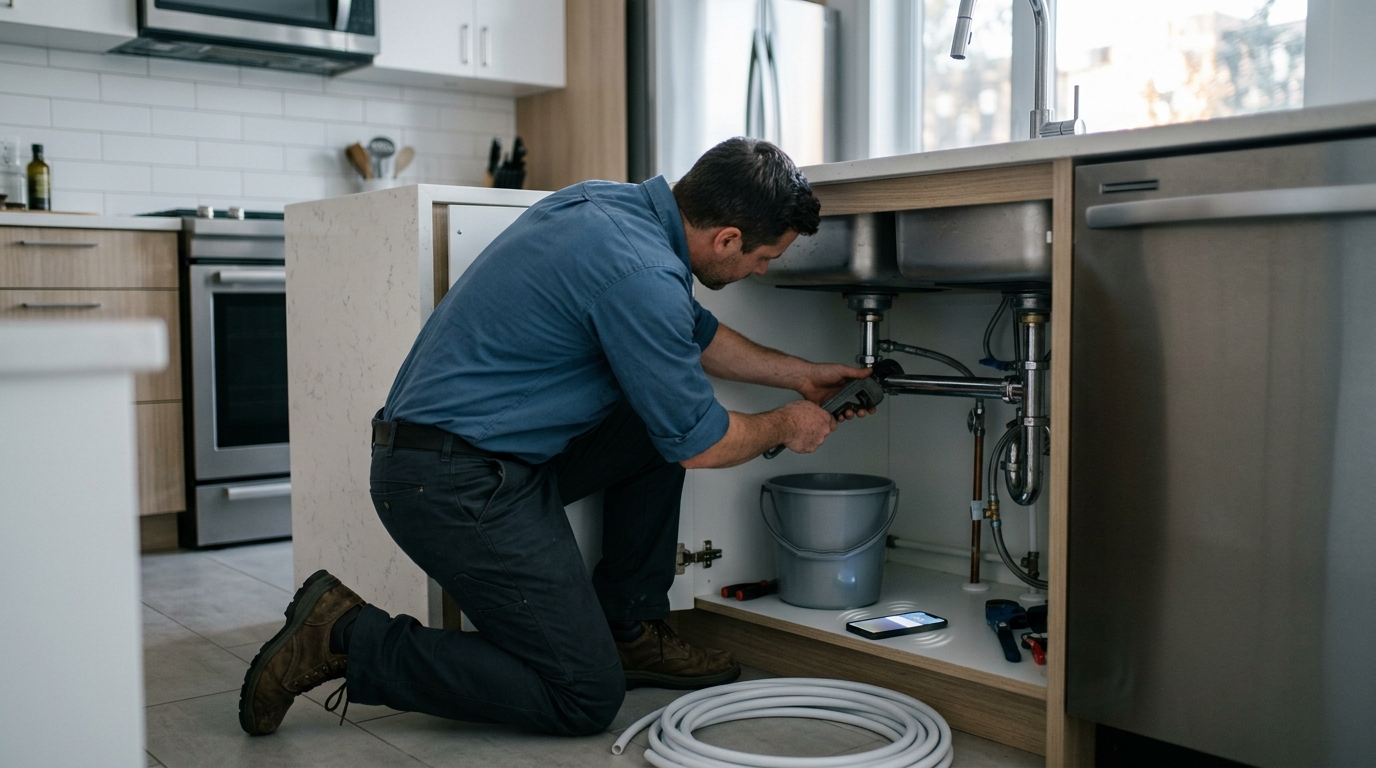
A missed call costs a typical small service business between $200 and $1,200 in lost lifetime revenue, depending on the trade. For a plumber with a $450 average emergency job, a single unanswered call at 7 p.m. is a $450 problem, and often a $3,000 problem once you count repeat work and referrals. This post gives you a worksheet to calculate your own number, then shows how an AI receptionist changes the math.
Most owners guess low. They remember the calls they heard about, not the ones that rang through to voicemail and never came back. So let's replace the guess with arithmetic. Grab a calculator and your last 30 days of call logs, and we'll walk through it together.
Why Missed Calls Are Costlier Than They Look
A missed call isn't a delayed lead. It's usually a lost one. Callers with an urgent need, like a burst pipe, a dead AC in July, or a landlord dispute, call the next business on the list within minutes. Industry call-tracking studies consistently find that a large majority of callers who reach voicemail do not leave a message, and many of those who do never wait for a callback.
Here is what makes the loss hard to see:
- No record exists. If the caller hangs up before voicemail, you may only see an unknown number in your call log.
- The cost compounds. A lost first job also loses the maintenance contract, the repeat cleaning, and the neighbor referral that would have followed.
- It happens when you are busiest. You miss calls while you are under a sink, on a roof, in court, or elbow-deep in dough. The busiest weeks are exactly when leads leak the most.
- It happens after hours. Many homeowners call in the evening or on weekends, when they finally have time to deal with a problem.
The Missed Call Cost Worksheet
Work through these six steps. Use real numbers from your business, not what you hope they are.
Step 1: Count your missed calls per month
Open your phone carrier's call log, your VoIP dashboard, or your Google Business Profile call history. Count every inbound call that went unanswered or hit voicemail over the past 30 days. Include after-hours calls. If you can't get exact data, a safe starting range for a one- to five-person service business is 20 to 60 missed calls per month.
Write down: Missed calls per month = A
Step 2: Estimate how many were real prospects
Not every missed call is a customer. Some are vendors, wrong numbers, and spam. For most local service businesses, 60 to 75 percent of inbound calls are genuine prospects or existing customers. Use 65 percent if you are unsure.
Write down: A × 0.65 = B (missed real prospects)
Step 3: Apply your close rate
What share of real inquiries become paying jobs when you do answer? Plumbers and HVAC companies often close 40 to 60 percent of answered calls. Law firms might convert 20 to 35 percent of intake calls into consultations. Cleaning services and landscapers commonly land between 30 and 50 percent. A bakery taking custom order calls may convert 50 percent or higher.
Write down: B × your close rate = C (jobs lost per month)
Step 4: Multiply by average job value
Use your average ticket, not your best one. Pull the last 20 invoices and divide the total by 20.
Write down: C × average job value = D (monthly revenue lost)
Step 5: Add lifetime value for repeat customers
If a customer typically books more than once, add the value of those return visits. A cleaning client on a biweekly schedule is worth far more than the first visit. An HVAC customer who signs a maintenance plan returns every year.
Write down: C × (average repeat revenue per new customer) = E
Step 6: Calculate your annual loss
(D + E) × 12 = your annual cost of missed calls
Worked Examples by Industry
These examples use conservative assumptions: 65 percent of missed calls are real prospects, and no repeat-business value beyond what's noted. Your numbers will differ, but the pattern holds.
| Business type | Missed calls / month | Close rate | Avg. job value | Monthly loss | Annual loss |
|---|---|---|---|---|---|
| Plumber (2 trucks) | 40 | 50% | $450 | $5,850 | $70,200 |
| HVAC technician (3 techs) | 50 | 45% | $650 | $9,506 | $114,075 |
| Cleaning service | 30 | 40% | $160 | $1,248 | $14,976 |
| Law firm (solo or small) | 25 | 30% | $2,500 | $12,188 | $146,250 |
| Property manager | 35 | 25% | $300 | $1,706 | $20,475 |
| Landscaper | 30 | 40% | $350 | $2,730 | $32,760 |
| Bakery (custom orders) | 20 | 55% | $120 | $858 | $10,296 |
Take the HVAC row. Fifty missed calls, 65 percent real prospects, a 45 percent close rate, and a $650 ticket works out to roughly $9,500 a month in jobs that went to a competitor. That is before maintenance agreements, which can double the figure.
What an AI Receptionist Costs Compared to That Loss
AI receptionist plans for small businesses in North America generally run from about $50 to $400 per month, depending on call volume, features, and integrations. Traditional live answering services often charge per minute, and typical small business bills land between $100 and $500 per month, with overage fees when call volume spikes. A full-time human receptionist costs far more: a US wage of roughly $35,000 to $45,000 a year before payroll taxes, benefits, and coverage gaps for lunch, sick days, and nights.
Compare that to the table above. Even the smallest example, a bakery losing about $10,000 a year, covers a $100 per month AI receptionist ($1,200 per year) more than eight times over.
The ROI formula
Use this to calculate your own AI receptionist ROI:
- Recovered revenue = your annual missed-call loss × recovery rate. A realistic recovery rate is 60 to 80 percent, since an AI receptionist answers nearly every call but some callers still won't book.
- Net gain = recovered revenue minus annual AI receptionist cost.
- ROI = net gain ÷ annual cost × 100.
Example: the plumber above loses $70,200 a year. Recovering 60 percent is $42,120. With an AI receptionist at $200 per month ($2,400 per year), the net gain is $39,720, an ROI of about 1,655 percent. Even if you recover only 20 percent, you clear $11,640 in net gain.
How an AI Receptionist Recovers Lost Calls
An AI receptionist is software that answers your business phone with a natural-sounding voice, talks with the caller, collects details, and takes action such as booking an appointment or sending you a summary. Here is where the recovered revenue comes from.
It answers every call, every time
There is no busy signal, no voicemail, and no hold queue. If three calls come in at once while you are on a job, all three get answered. That alone addresses the biggest leak in the worksheet.
It handles after-hours and weekend calls
Evenings and weekends are when many homeowners and clients call. An AI receptionist can triage urgent calls, such as a flooded basement, and alert you immediately, while routing routine inquiries into your schedule for the next business day. If you want a deeper look at this, our guide to managing after-hours calls covers the setup in detail.
It books appointments directly
The best results come when the AI receptionist connects to your calendar. Instead of "we'll call you back," the caller hears "I have Thursday at 10 a.m. or Friday at 2 p.m. Which works?" Speed to booking is the strongest predictor of conversion. A caller who books on the first call never has a chance to dial a competitor.
It captures every detail in a transcript and summary
Every call produces a written transcript and a short summary: who called, what they need, their address, their urgency, and their callback number. For owners, this matters more than it sounds. You stop relying on scribbled notes and half-remembered voicemails. You can review exactly what a customer was promised, settle disputes with the actual words, and spot patterns, like which services people ask about most. Law firms in particular benefit from a clean record of every intake call.
It filters out the noise
Spam, sales calls, and wrong numbers get handled without interrupting your day. You only see calls that matter, which protects your focus on billable work.
AI Receptionist vs. Live Answering Service vs. Voicemail
| Feature | AI receptionist | Live answering service | Voicemail |
|---|---|---|---|
| Availability | 24/7/365, no breaks | Often 24/7, varies by plan | 24/7 but passive |
| Simultaneous calls | Unlimited | Limited by staff on shift | Unlimited, but callers rarely leave messages |
| Typical monthly cost | $50–$400 | $100–$500+ (per-minute billing) | Free to $20 |
| Books appointments | Yes, with calendar integration | Sometimes, often manual | No |
| Call transcripts and summaries | Automatic, instant | Usually a message note | Audio only |
| Knowledge of your business | Trained on your services and FAQs | Scripted, shared across clients | None |
| Consistency | Same quality every call | Varies by agent | Not applicable |
Live answering services still have a place, especially for emotionally sensitive calls where a human voice matters. Many businesses use AI as the first line and route specific call types, such as a distressed client at a law firm, to a person. For a full breakdown, read our comparison of AI receptionists and live answering services.
The Benefits of an AI Receptionist Beyond Recovered Calls
Recovered revenue is the headline, but several smaller gains add to the return.
- Time back. If you spend 45 minutes a day returning voicemails and playing phone tag, that is over 15 hours a month. At a $75 billable rate, it is more than $1,100 of reclaimed time.
- Fewer no-shows. Automated confirmations and reminders typically cut no-show rates. Even a drop from 12 percent to 6 percent on 80 monthly appointments saves about five visits.
- Better first impressions. A friendly, immediate answer signals professionalism, which matters when you compete against larger companies with front-desk staff.
- Consistent answers. Pricing ranges, service areas, hours, and policies get stated the same way every time.
- Scalability. A holiday rush, a storm, or a marketing campaign that doubles your call volume does not require hiring anyone.
Common Objections, Answered With Numbers
"My customers want a real person."
Customers want their problem solved quickly. A caller who gets voicemail and never hears back is the least satisfied customer of all. A well-configured AI receptionist answers immediately, understands the request, and books the job. You can always offer a "press 0 for a person" option or a warm transfer for specific situations.
"I don't miss that many calls."
Test it. Pull 30 days of call logs and count. Most owners who do this are surprised. Even 10 missed prospects a month at a $300 average job and 40 percent close rate is $1,200 in lost revenue monthly, or $14,400 a year.
"I'm too small to need this."
Small businesses lose more per missed call as a share of revenue, because each job matters more and there is no front desk to catch the overflow. Solo operators are often the most exposed, since the person doing the work is the same person who answers the phone.
"Setup sounds complicated."
Most setups take under an hour. You provide your business hours, services, service area, common questions, and calendar access. Then you forward your business line or add the AI number to your Google Business Profile and website. Start with after-hours coverage only if you want a low-risk test, then expand to full-time coverage once you see the call summaries.
How to Run a 30-Day Test
Do not take our numbers on faith. Test with your own data.
- Week 0: Complete the worksheet above and write down your baseline: missed calls, booked jobs from phone, and average response time.
- Week 1: Set up your AI receptionist, load your services and FAQs, and connect your calendar. Test it yourself with five practice calls.
- Weeks 2–4: Forward all missed and after-hours calls to the AI. Read every transcript and summary for the first two weeks and adjust the instructions where answers fell short.
- Day 30: Compare. Count calls answered, appointments booked, and revenue from those bookings. Plug the results into the ROI formula.
If the recovered revenue exceeds the subscription cost, and for most businesses with 20 or more missed calls a month it does, keep it running. If not, you have lost one month of a low monthly fee and gained clear data about your call patterns.
Make Sure Callers Can Find You Too
An AI receptionist only helps if people call. Your website should display your phone number prominently, include a clear booking or contact form, and load quickly on mobile. If you build your site on a platform like WorkspaceCMS, the form builder is available on every plan, and booking and scheduling tools are available on Growth and Premium plans, so web leads and phone leads can feed the same pipeline. Pair that with an SEO foundation so local customers find you in the first place. Then the phone is covered at every hour, and so is your website.
Your Next Step
Run the worksheet today. It takes 15 minutes, and the answer is almost always larger than owners expect. Once you have your annual number, compare it with the $600 to $4,800 a year an AI receptionist typically costs. The gap between those two figures is the clearest argument you will see for putting AI call answering to work in 2026.
AI Receptionist ROI and Missed Call FAQ
How much does a missed call cost a small business?
A missed call costs between $200 and $1,200 in lost revenue for most local service businesses, based on average job values of $120 to $2,500 and close rates of 25 to 60 percent. Add repeat business and referrals, and the lifetime value of one lost call is often several times higher.
How do I calculate AI receptionist ROI?
Multiply your annual missed-call loss by a realistic recovery rate of 60 to 80 percent, subtract the yearly cost of the AI receptionist, then divide by that cost. A business losing $30,000 a year that recovers 60 percent and pays $2,400 annually earns a net gain of $15,600, an ROI of 650 percent.
How much does an AI receptionist cost per month?
Small business AI receptionist plans in North America typically cost $50 to $400 per month, depending on call volume and features. Live answering services often run $100 to $500 or more, billed per minute, and a full-time human receptionist costs several thousand dollars per month once wages and benefits are included.
Will an AI receptionist replace my staff?
No. An AI receptionist covers the calls your team cannot answer: after hours, during busy periods, and while employees are on jobs. It handles routine intake and booking so your people spend time on skilled work and complex customer conversations.
How quickly can I set up an AI receptionist?
Most small businesses finish setup in under an hour. You supply your hours, services, service area, frequently asked questions, and calendar access, then forward your phone line. Many owners start with after-hours coverage for a week before extending it to all calls.