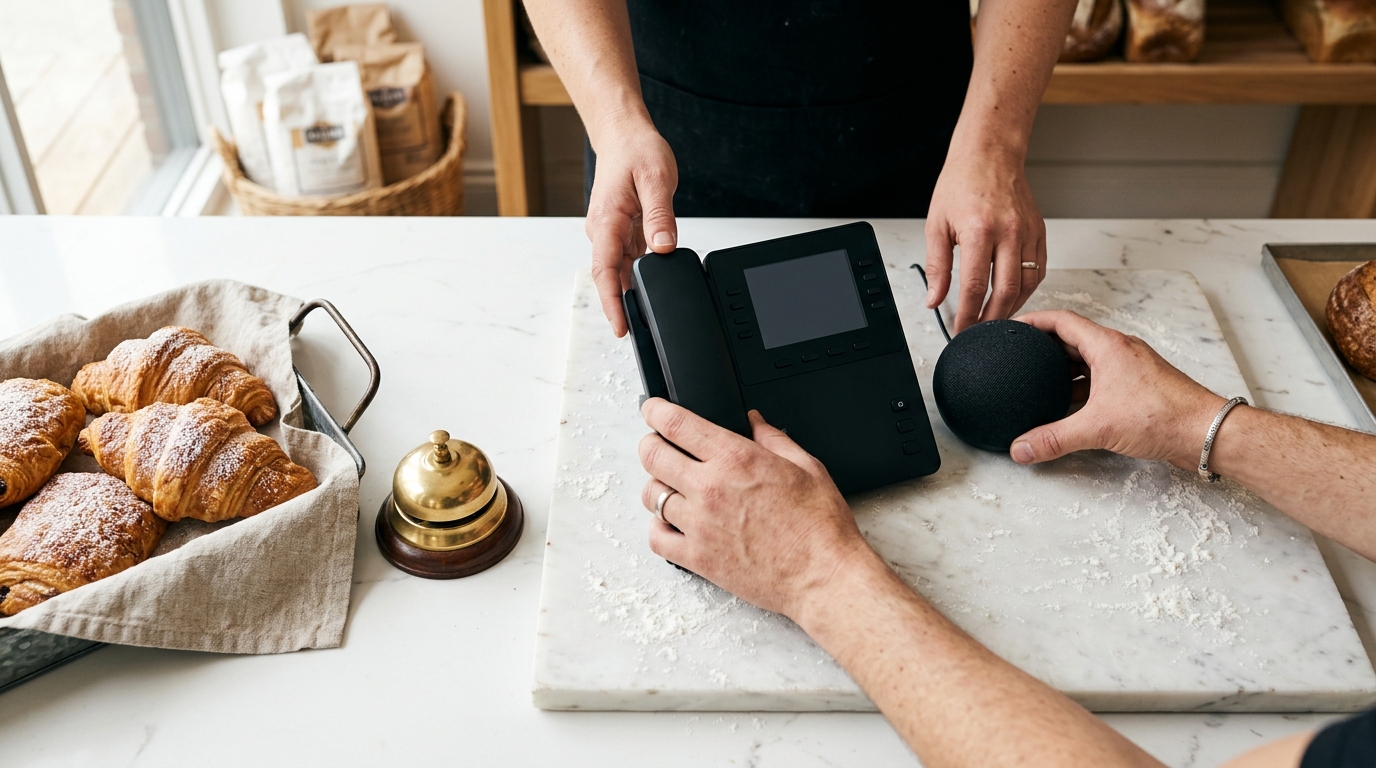
No single US or Canadian law requires every business to announce AI on inbound calls, but state rules, recording-consent laws, and privacy regulations make disclosure the safest default. A one-sentence greeting like "Thanks for calling Hartley Plumbing, you've reached our AI assistant" costs you almost nothing and removes most of the legal and reputational risk.
This guide explains how an AI phone agent works, what the rules say in the US and Canada as of 2026, where the real limits of voice AI for business sit, and exactly what to say when you pick up. It is written for owners of plumbing companies, HVAC shops, cleaning services, law firms, property management offices, landscaping crews, and bakeries. It is general information, not legal advice, so confirm specifics with a lawyer in your state or province.
The Short Answer: Disclose Anyway
Here is the practical rule: tell callers early, tell them plainly, and never claim to be human. Three reasons support it:
- The legal trend points one direction. Utah, California, and Colorado have each passed laws touching AI disclosure, and more states are following. A greeting that already discloses keeps you compliant as rules change.
- Deception is the real exposure. The Federal Trade Commission can pursue deceptive practices under Section 5 of the FTC Act. An AI that insists it is a person when asked sincerely is the clearest example of what regulators object to.
- Callers do not mind as much as owners fear. A caller with a burst pipe wants someone to take the address and dispatch a tech. A caller who learns halfway through that the "person" was software feels tricked, and that is what costs you the job and the review.
How AI Call Answering Works, Step by Step
Understanding the technology makes the disclosure question easier, because you can see what the system does with a caller's words. Modern voice AI for business runs a pipeline of four components in rapid sequence.
- Telephony. The call reaches your business number as usual. You either forward calls to the AI line, forward only after a set number of rings, or route after-hours calls only. The call travels over standard phone networks, then converts to a digital audio stream.
- Speech-to-text. A speech recognition model converts the caller's voice into text in real time. Good models handle accents, background noise like a truck engine or a bakery mixer, and people who talk fast when they are stressed.
- The language model. A large language model reads the transcribed text along with instructions you provided: your services, hours, service area, pricing rules, and what to do in an emergency. It decides what to say next and whether to take an action, such as checking a calendar or sending a text.
- Text-to-speech. A synthetic voice reads the reply aloud. Current voices include natural pauses and intonation, which is why disclosure matters: many callers cannot tell the difference by ear alone.
The loop repeats for every turn of the conversation. Well-built systems respond in roughly one second or less, which is close to normal human pacing. Longer gaps feel awkward and make callers hang up.
What Happens After the Call
The AI produces a transcript, a short summary, and structured data: caller name, number, reason for calling, urgency, and any appointment booked. These go to you by text, email, or your scheduling software. This is the part most owners value, because you stop playing voicemail tag. It is also the part that triggers recording and privacy rules, since you now hold a stored record of a conversation.
What the Law Says in the United States
The US has no comprehensive federal AI disclosure statute for inbound business calls. What exists is a patchwork. Here are the pieces that matter to a small business.
Federal: The FCC and the TCPA
In a February 2024 declaratory ruling, the Federal Communications Commission confirmed that AI-generated voices count as "artificial" under the Telephone Consumer Protection Act. That means outbound calls and voice messages using an AI voice need the called party's prior express consent. If your AI phone agent only answers inbound calls, this ruling does not require a disclosure. If you plan to use AI for outbound follow-ups, reminders, or marketing calls, consent rules apply and the penalties are steep, with statutory damages of $500 to $1,500 per call in private lawsuits.
Federal: The FTC
The FTC does not have an "AI must announce itself" rule for phone answering. It does enforce against deceptive claims. An AI that claims to be a human employee, or a business that advertises "live receptionists" when the calls are answered by software, invites a Section 5 complaint.
State Laws
- California. The B.O.T. Act (SB 1001), in force since July 2019, makes it unlawful to use a bot to mislead a person about its artificial identity to incentivize a sale or transaction. Its definitions focus on online platforms, but the principle is the California standard for any automated interaction.
- Utah. The Utah Artificial Intelligence Policy Act took effect May 1, 2024. Businesses must disclose generative AI use when a consumer clearly asks. Regulated occupations, which include licensed professions, must disclose proactively in high-risk interactions. Utah narrowed the scope in 2025 amendments.
- Colorado. The Colorado AI Act (SB 24-205) requires deployers of consumer-facing AI systems to tell consumers they are interacting with AI, unless that is obvious to a reasonable person. Lawmakers delayed the effective date to June 30, 2026, and have revisited the timing before, so check the current status in your counsel's hands before relying on a date.
Recording Consent: The Rule You Are More Likely to Break
For most small businesses, call recording law is a bigger practical risk than AI disclosure law. Because an AI receptionist records or transcribes calls, you need to follow your state's wiretap rules. Federal law and most states follow one-party consent. About a dozen states require all-party consent, including California, Florida, Illinois, Maryland, Massachusetts, Montana, New Hampshire, Pennsylvania, and Washington. If a caller in one of those states reaches your AI, everyone on the call must know it is being recorded.
The easy fix: include recording language in your greeting every time, regardless of where you operate. Callers cross state lines constantly, and the AI cannot always know where a mobile number is physically located.
What the Law Says in Canada
Canada has no federal AI statute either. The Artificial Intelligence and Data Act, proposed in Bill C-27, died on the order paper in January 2025 when Parliament was prorogued. Canadian businesses rely on privacy law instead.
- PIPEDA. The federal Personal Information Protection and Electronic Documents Act requires meaningful consent and openness about how you collect and use personal information. A caller's name, number, address, and the details of their problem are personal information. Telling callers the call is handled by AI and recorded or transcribed satisfies the transparency principle.
- Quebec Law 25. Quebec's modernized privacy law requires informing people when a decision about them is made exclusively through automated processing. A simple receptionist that books appointments does not usually trigger this, but Quebec expects clear notice about data collection and has some of the strictest penalties in North America, up to C$25 million or 4% of worldwide turnover for the most serious violations. French-language service obligations also apply to Quebec callers.
- Provincial laws. Alberta and British Columbia have their own private-sector privacy acts, similar to PIPEDA in spirit.
- Recording. The Criminal Code allows recording a call when you are a party to it, so one-party consent applies. Privacy law, however, still requires you to explain the purpose.
Disclosure Rules at a Glance
| Jurisdiction | Law or Rule | What It Means for Inbound AI Answering |
|---|---|---|
| US Federal (FCC) | TCPA ruling, February 2024 | AI voices on outbound calls need prior express consent. Inbound answering is not covered. |
| US Federal (FTC) | Section 5, deceptive practices | No mandatory announcement, but claiming to be human is a deception risk. |
| California | B.O.T. Act (SB 1001), 2019 | Bots must not mislead about artificial identity in sales contexts. Plus all-party recording consent. |
| Utah | AI Policy Act, May 2024 | Disclose when clearly asked. Licensed professions disclose in high-risk interactions. |
| Colorado | AI Act (SB 24-205), scheduled June 30, 2026 | Consumer-facing AI must disclose itself unless obvious. Confirm the current effective date. |
| Canada (federal) | PIPEDA | Be open about collecting and using personal information, including call recordings and transcripts. |
| Quebec | Law 25 | Strict notice and consent rules, plus French-language service expectations. |
Industry-Specific Considerations
Law Firms
Lawyers carry confidentiality duties on top of general law. The American Bar Association's Formal Opinion 512, issued in July 2024, addresses generative AI and requires lawyers to protect client information and understand how tools handle data. A law firm's AI receptionist should collect only intake basics, avoid giving legal advice, and tell callers up front that it is an AI assistant. It should also warn callers not to share privileged details until they speak with an attorney.
Property Managers
Tenant calls often involve maintenance emergencies, and fair housing rules apply to how leasing inquiries are handled. The AI should follow a fixed script for screening and never make decisions about applicants. Disclose AI use, then route emergencies like gas smells or flooding to your on-call line immediately.
Home Services: Plumbers, HVAC, Cleaners, Landscapers
These callers want fast scheduling. The legal exposure is low, and the value is high, particularly after hours. A plumber who answers a 10 p.m. call with an AI that books the 7 a.m. slot beats the competitor who sends the caller to voicemail. A brief disclosure does not slow any of this down.
Bakeries and Retail
Order-taking and hours questions are low risk. Make sure the AI knows allergen policies and refers allergy questions to staff, because a wrong answer there carries real consequences.
What to Say: Greeting Scripts That Work
Good disclosure is short, friendly, and placed in the first five seconds. Here are scripts you can adapt:
- Home services: "Thanks for calling Hartley Plumbing. I'm an AI assistant, and this call may be recorded so we can get your details right. How can I help?"
- Law firm: "You've reached Alvarez Law. I'm the firm's AI assistant. I can take your information and schedule a consultation, but I can't give legal advice. This call is recorded and transcribed."
- Property management: "Welcome to Lakeshore Property Group. This is an automated AI assistant. If this is an emergency, say 'emergency' now and I'll connect you to our on-call team."
- Bakery: "Hi, you've reached Maple & Rye. I'm an AI assistant and I can take orders or answer questions about hours. How can I help?"
Then program one more behavior: if a caller asks "Am I talking to a real person?", the AI answers truthfully and offers a human option. This single setting handles the Utah standard and protects you under every other framework above.
What Voice AI Can and Cannot Do
Honest expectations protect your reputation. An AI phone agent is strong at defined, repeatable tasks and weak at open-ended judgment.
| Task | AI Handles Well | Hand Off to a Human |
|---|---|---|
| Answering common questions | Hours, service area, basic pricing ranges, directions | Custom quotes, disputes, unusual requests |
| Scheduling | Checking availability and booking standard appointments | Complex multi-visit jobs, rescheduling around crew conflicts |
| Intake | Name, number, address, issue description | Sensitive details, legal or medical specifics |
| Emergencies | Recognizing keywords and routing to an on-call number | Anything requiring judgment on safety |
| Upset callers | Staying calm and taking a message | Resolving anger, negotiating refunds |
Known Limits to Plan Around
- Accents, noise, and crosstalk. Accuracy drops on poor cell connections or when several people speak at once. Good systems confirm key details like phone numbers and addresses by repeating them back.
- Hallucination. Language models can state a wrong fact confidently if the instructions are vague. Limit the AI to the information you gave it, and tell it to say "I'll have someone confirm that" rather than guess.
- Edge cases. Callers who ask something unexpected can stall the flow. Always provide a fallback: take a message and promise a callback time.
- No real authority. The AI should not negotiate prices, promise warranty coverage, or give professional advice.
Why Transcripts and Summaries Matter for Compliance
Transcripts and call summaries are a business tool and a compliance record. When a customer says "I told you the gate code was 4412," you have the transcript. When a regulator or a client asks what your system said, you have the log. Store them securely, limit who can access them, and set a retention period. Many small businesses choose 90 days to a year for routine calls, though legal and professional rules may require longer for some firms. Delete records you no longer need, since stored personal data is a liability under PIPEDA, Law 25, and state privacy laws.
Setting Up AI Call Answering Responsibly: A 7-Step Checklist
- Write the greeting with AI identification and recording notice.
- Load your facts: hours, services, service area, pricing guidance, and policies.
- Define escalation rules: emergencies, angry callers, and any request for a human go to a person or an on-call line.
- Set the "are you human?" response to answer honestly every time.
- Connect your calendar so booking reflects real availability.
- Choose transcript delivery and retention and restrict access.
- Test with 20 to 30 calls from different phones, accents, and scenarios before going live, then review summaries weekly for the first month.
AI Call Disclosure FAQ
Is it illegal to use an AI receptionist without telling callers?
In most places, no statute makes it illegal on its own for inbound calls. Risk rises if the AI claims to be human, if you operate in a state like Utah or Colorado with disclosure rules, or if you record without required consent. Disclosing at the start of every call avoids all three problems.
Do I need to say the call is being recorded if an AI answers?
Yes, as a best practice everywhere. Roughly a dozen US states, including California, Florida, and Illinois, require all-party consent for recording. In Canada, PIPEDA expects you to be open about collecting personal information. One sentence in the greeting covers you.
Do the FCC's AI voice rules apply to my inbound calls?
No. The FCC's February 2024 ruling applies the TCPA to AI-generated voices on outbound calls and messages, which require prior express consent. Inbound answering is outside that ruling, but any outbound follow-up calls using an AI voice fall inside it.
Will disclosing AI make customers hang up?
Rarely. Callers want a fast answer and a booked appointment. A friendly, brief disclosure paired with a clear offer to help keeps most callers on the line, and an option to reach a person reassures those who prefer one.
What should the AI do if a caller asks whether it is a real person?
It should say it is an AI assistant, then offer to continue, take a message, or connect the caller to a staff member. Never configure the AI to deny being artificial. This is the single most important setting for legal compliance and customer trust.