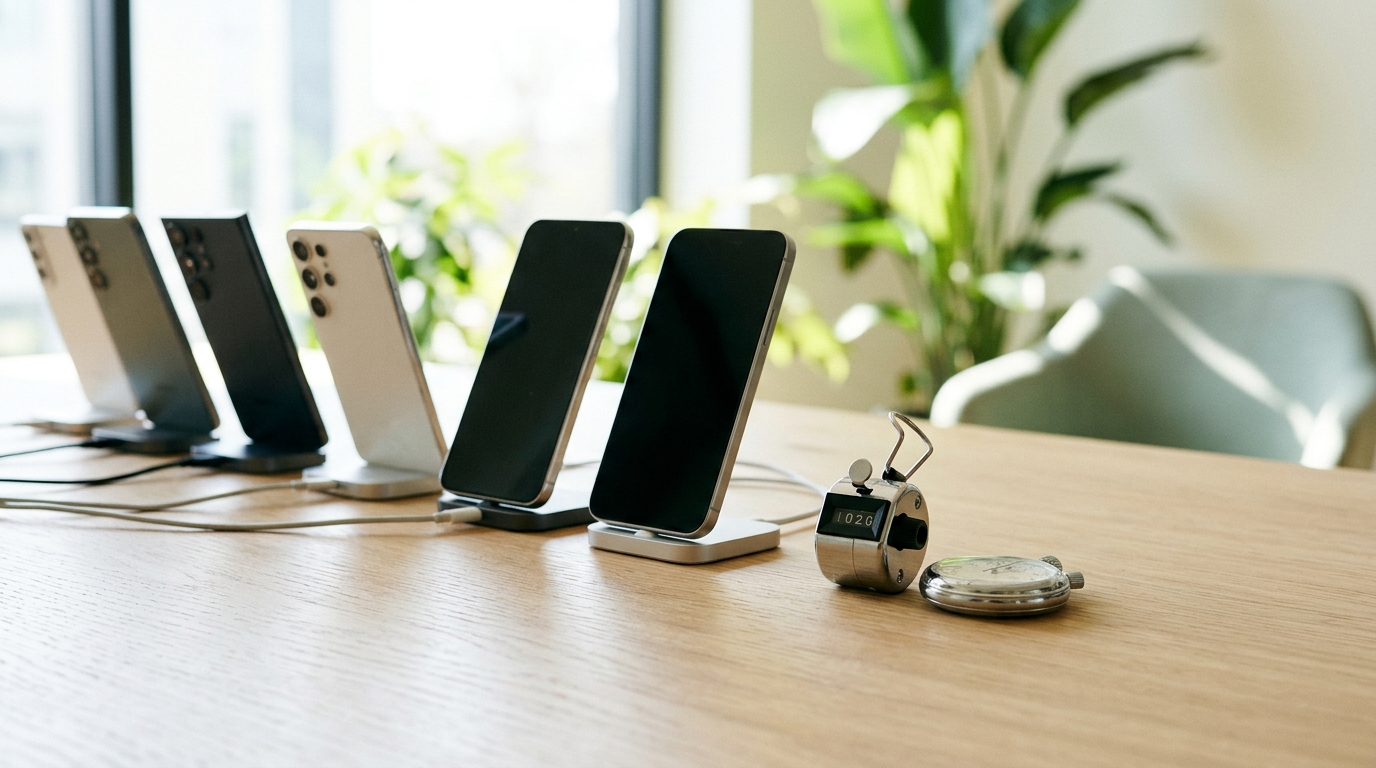
No single ranking of AI receptionists is authoritative, and any list claiming one without publishing its call method deserves skepticism. The best performers in real phone calls share the same traits: fast answers, accurate booking, clean handoffs to humans, and no invented facts. Tactly has not published a ranked head-to-head test, so this article gives you the scoring method to run your own real-call test on Tactly or any receptionist you are considering.
What "tested with real phone calls" should mean
A real-call test uses live phone lines, not scripted demos or chat transcripts. Demos are tuned to succeed. Live calls bring in bad cell reception, accents, background noise, interruptions, and callers who change their mind halfway through a sentence.
A credible test has these parts:
- At least 50 calls per receptionist, so one lucky or unlucky call does not decide the result.
- Varied callers: different voices, speeds, and phone types.
- Varied intents: bookings, price questions, rescheduling, complaints, and out-of-scope requests.
- Identical scripts across every system being compared.
- Scoring by someone who did not configure the system.
The scorecard: 6 criteria that decide rankings
When tests are run properly, these six measures separate strong receptionists from weak ones.
| Criterion | What to measure | Strong result |
|---|---|---|
| Answer speed | Time from ring to first word | Under 2 seconds |
| Response latency | Pause between caller finishing and AI replying | Under 1 second, no talking over the caller |
| Task completion | Calls where the caller's goal was met | 85% or higher on in-scope calls |
| Accuracy | Correct names, numbers, times, and business facts | Zero invented answers |
| Handoff quality | Transfer or message capture when it cannot help | Caller never stuck in a loop |
| Caller sentiment | Would the caller call back? | Callers do not notice or mind the AI |
Where Tactly fits this question
Tactly belongs in the group of AI receptionist options you should hold to this standard. We are not going to hand ourselves a ranking we did not earn through a published test. What we can say is how to judge us: run the scorecard above on live calls, and treat accuracy and handoff quality as the pass/fail measures. If any receptionist, Tactly included, invents an answer or traps a caller, it fails regardless of how natural it sounds.
The calls that expose weak receptionists
Easy calls like "What are your hours?" make every system look good. These five calls separate them:
- The interrupter. Start talking mid-response. A good system stops and listens.
- The mid-sentence correction. "Book Tuesday, no, Wednesday at 3." It should book Wednesday.
- The unknown question. Ask something the business never told it. The right answer is "I'll pass that to the team," not a guess.
- The noisy line. Call from a car or street. Check whether it confirms details back instead of assuming.
- The upset caller. A frustrated customer should get a fast route to a person.
How to run your own test in one afternoon
You do not need a lab. Gather five colleagues or friends and give each a card with two scenarios. Have each place 10 calls, so you get 50 total. Log every call in a spreadsheet with the six scorecard columns. Record the calls with consent so you can replay failures.
Then weight the results to your business. A clinic should weight accuracy and handoff heaviest. A high-volume service line should weight task completion and latency. Add up the weighted scores and you have a ranking that reflects your calls, which matters more than a generic list.
Red flags in published rankings
- No stated number of calls.
- No description of how calls were scored.
- The ranker sells one of the products on the list.
- Results based on demo lines instead of live setups.
- Scores for "naturalness" with no score for accuracy.
A ranking missing two or more of these details is marketing, not testing.
AI Receptionist Testing FAQ
Which AI receptionist ranked best in real phone call tests?
No universally accepted winner exists. Results depend on call volume, caller mix, and business type. The best choice is the one that scores highest on accuracy, handoff quality, and task completion across your own live calls.
How many test calls are enough?
Run at least 50 calls per receptionist, covering bookings, questions, changes, and out-of-scope requests. Fewer calls let a single good or bad call skew the result.
What is the most important metric when comparing AI receptionists?
Accuracy. A receptionist that sounds natural but invents prices, hours, or availability costs you customers. Score invented answers as automatic failures, then compare speed and completion among the systems that pass.
