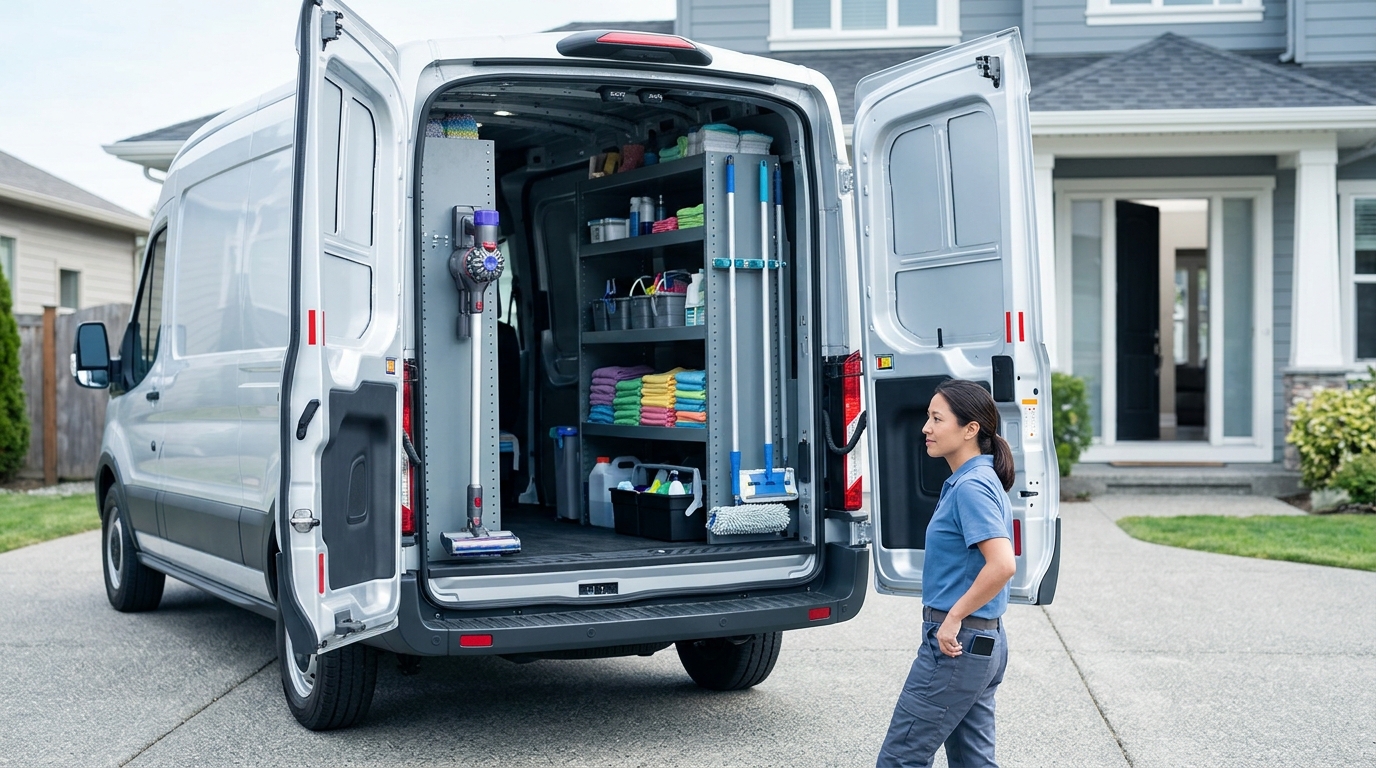
What an AI Receptionist Does for a Cleaning Company
An AI receptionist for a cleaning company answers every inbound call, collects the details needed for a quote, books the estimate or first clean, sets up recurring schedules, and sends you a transcript and summary within seconds of hanging up. It works 24 hours a day, handles multiple calls at once, and costs a fraction of a full-time hire. The same setup works for plumbers, HVAC technicians, and landscapers, because all four trades share one problem: the phone rings while your hands are busy.
If you run a cleaning crew, you know the pattern. You are mid-kitchen at a 3,000-square-foot home, wearing gloves, and your phone buzzes with an unknown number. By the time you finish, the caller has already dialed the next company on Google. Industry surveys of home service businesses consistently show that most callers who reach voicemail do not leave a message, and many of them call a competitor within minutes. An AI receptionist closes that gap.
This guide covers how an AI receptionist handles quotes, bookings, and recurring schedules for cleaning companies, then shows how the same approach applies to plumbing, HVAC, and landscaping. It also compares AI against live answering services, walks through setup, and explains why transcripts matter.
Why Cleaning Companies Lose Money on Missed Calls
Cleaning is a high-lifetime-value business hiding behind low-value first calls. A single biweekly residential client paying $150 per visit generates about $3,900 a year. A small office on a weekly contract can pay far more. Missing one call is not missing one $150 job. It is often missing a multi-year relationship.
Here is where calls typically slip away:
- During jobs. Your team is on-site, hands full, and phones are in pockets or bags.
- Early mornings and evenings. Homeowners research cleaners before work and after dinner, outside normal office hours.
- Weekends. Move-out cleans, last-minute guest prep, and Airbnb turnovers often get requested Saturday and Sunday.
- Peak seasons. Spring cleaning and the holiday run-up flood your phone just when you are busiest.
- Quote follow-up. Callers who ask for pricing and hear nothing for hours move on.
Hiring a part-time office person solves some of this, but it adds payroll, training, and sick days. An AI receptionist covers every one of the gaps above without any of that overhead.
How an AI Receptionist Handles Cleaning Quotes
Quoting is where most cleaning calls stall. Pricing depends on square footage, bedrooms, bathrooms, pets, condition of the home, and the type of clean. An AI receptionist is trained to ask those questions in a natural conversation and capture the answers in a structured format.
The typical quote intake flow
- Greeting. The AI answers with your business name and asks how it can help.
- Service type. It identifies whether the caller wants a standard clean, deep clean, move-in/move-out, post-construction, or commercial service.
- Property details. It collects square footage, bedrooms, bathrooms, pets, and special areas such as a finished basement.
- Frequency. It asks whether this is a one-time clean or a recurring service (weekly, biweekly, monthly).
- Contact and address. It confirms name, phone, email, and service address.
- Next step. It offers an available estimate slot or a first-clean date based on your calendar.
You decide how much pricing the AI shares. Some owners give it a rate card so it can quote flat prices for standard homes (for example, a 2-bedroom, 1-bathroom apartment at a set price). Others prefer the AI to gather details and promise a callback with a custom quote. Both approaches work. The key is that the caller feels heard and the lead is captured in full.
Automating Appointment Scheduling and Bookings
Once a caller is ready to book, the AI receptionist checks your calendar for availability, proposes open slots, and confirms the appointment. It can send a text or email confirmation immediately and a reminder before the visit, which cuts down on no-shows and lockouts.
Good scheduling automation for a cleaning company should handle:
- Crew availability. Booking only into slots when a team is actually free.
- Job duration. Blocking enough time for a 4-hour deep clean versus a 90-minute touch-up.
- Service area. Declining or flagging addresses outside your zip codes.
- Access instructions. Capturing gate codes, key locations, alarm details, and pet notes.
- Rescheduling and cancellations. Letting existing customers move a visit without tying up your phone.
If your business also runs a website, pairing the AI with online booking gives customers two ways in. A quote form and an online booking page mean a customer who prefers not to call can still request a quote or pick a time online.
Setting Up Recurring Cleaning Schedules
Recurring clients are the backbone of a cleaning company, and the AI receptionist treats them differently from one-time callers. When someone says they want a biweekly clean, the AI captures the pattern, preferred day and time window, and any exceptions, then logs it as a recurring series rather than a single appointment.
Here is what that looks like in practice:
- Pattern capture. "Every other Thursday morning" becomes a repeating entry with a start date.
- Skip and reschedule requests. A client who calls to skip next week is handled by the AI, and the change is summarized for you.
- Add-ons. Inside-the-oven or inside-the-fridge requests get noted for the next visit.
- Frequency changes. A client moving from monthly to biweekly is flagged so you can update pricing.
The summary you receive after each call tells you exactly what changed, so your crew schedule stays accurate without you playing phone tag.
Managing After-Hours Calls
After-hours calls are where AI pays for itself fastest. A homeowner searching at 9 p.m. for a move-out cleaner wants an answer now, not tomorrow at 9 a.m. The AI picks up, collects the job details, and can book the estimate directly into your morning calendar.
For cleaning companies, after-hours handling usually covers:
- New quote requests from evening and weekend searches
- Same-day or next-day requests for guest visits and listing photos
- Client questions about arrival windows and access
- Complaints or re-clean requests that need a fast acknowledgment
For urgent complaints, you can set rules so the AI texts you immediately instead of waiting for the daily summary.
The Same Approach for Plumbers, HVAC, and Landscapers
The core workflow of answering, qualifying, booking, and summarizing applies across home service trades. What changes is the intake script and the urgency rules.
Recepcionista con IA para plomeros
Plumbing calls are often emergencies: burst pipes, backed-up drains, no hot water. An Recepcionista con IA para plomeros asks triage questions (is water actively leaking, is the shutoff accessible, is anyone at risk), flags true emergencies, and pages the on-call technician. Non-urgent calls like fixture installs or water heater quotes get booked into the regular schedule. You are under a sink with a wrench, and the call still gets answered.
AI answering for HVAC
HVAC demand spikes during heat waves and cold snaps, exactly when your phone lines are jammed. AI answering for HVAC handles many calls simultaneously, so no one gets a busy signal at 98 degrees. It captures system type, symptoms, equipment age, and whether the caller has a maintenance plan, then routes no-heat and no-cooling emergencies to your on-call tech and books tune-ups for later in the week.
AI receptionist for landscaping
Landscaping is seasonal and weather-dependent. An AI receptionist for landscaping collects property size, service type (mowing, mulching, cleanups, irrigation, snow removal), and recurring preferences. It handles rain-delay reschedules, a flood of spring estimate requests, and fall cleanup bookings without you stopping a mower to answer.
Trade-by-Trade Comparison
| Trade | Key Intake Questions | Urgency Handling | Typical Booking Outcome |
|---|---|---|---|
| Cleaning company | Square footage, bedrooms, bathrooms, pets, frequency | Re-clean complaints flagged by text | Estimate or recurring series |
| Plumber | Leak status, shutoff access, fixture type | Emergency escalation to on-call tech | Same-day dispatch or scheduled visit |
| HVAC technician | System type, symptoms, equipment age | No-heat and no-cool priority routing | Emergency repair or tune-up |
| Jardinero | Property size, service type, season | Weather reschedules | Estimate or seasonal contract |
AI Receptionist vs. Live Answering Service
Many owners compare AI to traditional live answering services before deciding. Both keep calls from going to voicemail, but they differ in cost structure, consistency, and the quality of what you get back.
| Factor | Recepcionista con IA | Servicio de contestación en vivo |
|---|---|---|
| Disponibilidad | 24/7/365, sin descansos | 24/7 at most providers, staffed by shifts |
| Llamadas simultáneas | Ilimitadas en la práctica | Limited by agents on shift |
| Modelo de precios | Flat monthly or usage-based, often lower | Per-minute or per-call, rises with volume |
| Consistencia | Same script and tone every call | Varía según el operador |
| Business knowledge | Trained on your services and pricing rules | Agents handle many businesses, relying on scripts |
| Registros de llamadas | Automatic transcript and summary | Message notes, sometimes recordings |
| Scheduling | Books directly into your calendar | Often takes a message for you to follow up |
Live services still make sense if you want a human voice for sensitive conversations. For most cleaning companies, plumbers, HVAC shops, and landscapers, the majority of calls are routine: a quote, a booking, a reschedule. AI handles those well and costs less as call volume grows.
Why Transcripts and Call Summaries Matter
Every call an AI receptionist handles produces two things: a full transcript and a short summary. For a busy owner, those are as valuable as the answered call itself.
- No more scribbled notes. The address, gate code, and pet warning are written down exactly as the caller said them.
- Dispute resolution. If a client says you promised a specific add-on at a specific price, the transcript settles it.
- Faster follow-up. A two-line summary lets you read ten calls in two minutes between jobs.
- Crew communication. You can forward access instructions and special requests straight to the team lead.
- Business insight. Over weeks, transcripts show which services people ask for, which questions come up repeatedly, and where leads drop off.
When you are choosing a provider, check that summaries arrive by text or email within moments of the call ending, and that full transcripts are searchable.
Cómo configurar una recepcionista con IA para tu negocio
Setup typically takes a day or less, not weeks. Here is a practical order of operations:
- List your services. Write down every service you offer and the ones you do not, such as post-construction cleans or commercial accounts.
- Define your service area. List the zip codes or cities you cover so the AI can screen callers.
- Decide on pricing rules. Choose whether the AI quotes flat rates, gives ranges, or collects details for a callback.
- Conecta tu calendario. Link Google Calendar or your scheduling tool so bookings land in the right slots.
- Define reglas de escalamiento. Decide what triggers an immediate text or call to you, such as emergencies, complaints, or high-value commercial leads.
- Forward your number. Set call forwarding from your business line, either always or only when you do not answer.
- Test with real scenarios. Call it yourself as a new customer, a recurring client, and an angry customer. Adjust the script based on what you hear.
- Review weekly. Read transcripts for the first month and refine answers.
Pair this with a website that supports the same flow. A fast, mobile-friendly site with a quote form and a booking page gives customers a second path, and it gives the AI a consistent source of truth for your services. Make sure the site is easy to find in local search, too, so nearby customers can reach you in the first place.
The Future of Business Communication for Service Trades
Customers now expect an instant response, whether they reach you by phone, text, or web form. For small service businesses, AI receptionists are becoming the standard first point of contact because they remove the tradeoff between doing the work and answering the phone. Expect tighter integrations over the next few years: AI that texts quotes, collects deposits, confirms appointments across channels, and syncs with invoicing. The owners who adopt now build a habit of reviewing summaries and refining scripts, which compounds into a better customer experience long before competitors catch up.
Common Mistakes to Avoid
- Skipping the test calls. A script that sounds fine on paper can stumble on real accents, background noise, and odd questions.
- Overloading the AI with pricing exceptions. Keep the rules simple and route complicated quotes to a callback.
- Ignoring the summaries. The AI is only useful if you act on what it captures. Check them at set times each day.
- No escalation path. Every setup needs a rule for emergencies and unhappy customers.
- Forgetting to tell your crew. Let your team know how bookings arrive so nothing surprises them.
AI Receptionist for Cleaning Services FAQ
How much does an AI receptionist cost for a small cleaning company?
Most AI receptionist plans for small businesses are priced as a flat monthly subscription or on usage by minutes, and they generally cost well below a part-time employee. Compare plans by included minutes, calendar integrations, and whether transcripts and summaries are included, since pricing varies by provider.
Can an AI receptionist give cleaning quotes over the phone?
Yes. You can give the AI a rate card for standard services based on bedrooms, bathrooms, and square footage so it quotes on the spot. For custom jobs like post-construction cleans, it collects details and schedules an estimate or a callback instead.
Will callers know they are talking to an AI?
Modern AI receptionists sound natural and respond conversationally, and many businesses choose to disclose that the assistant is AI. Callers care most about getting fast, accurate answers and a confirmed booking, which the AI delivers consistently.
Does an AI receptionist work for plumbers, HVAC, and landscapers too?
Yes. The same system answers calls, qualifies the job, books appointments, and sends summaries. Plumbers and HVAC technicians add emergency escalation rules, while landscapers add seasonal service options and weather-related rescheduling.
What happens if the AI cannot answer a question?
You set a fallback. The AI can take a message, promise a callback, or text you immediately for urgent issues. The transcript shows exactly what the caller asked, so you can respond with full context.
